Vectored_Illus
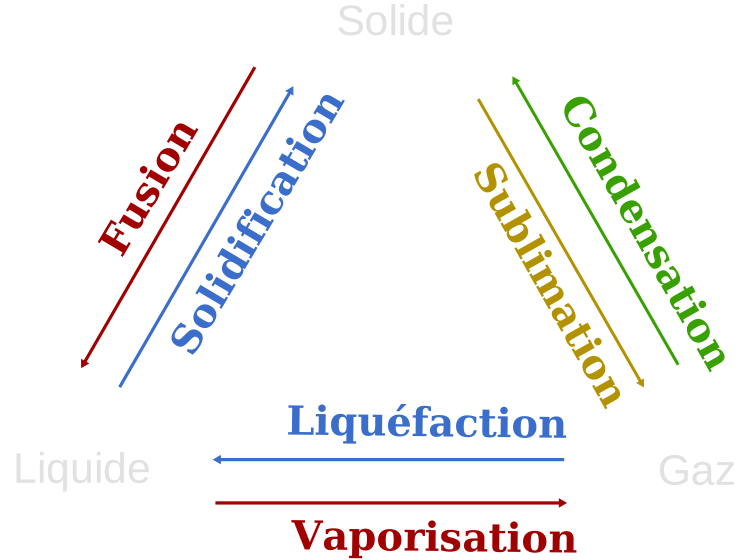

Matter exists in three states: solid, liquid and gas.
When it changes from one state to another, it is called a change of state.
Examples:
Each transformation takes place at a very specific temperature, called the change of state temperature.
Example with pure water:
The melting temperature is the same as the solidification temperature: 0 °C
You can measure these temperatures yourself with a thermometer. A substance is heated (or cooled) and its temperature is recorded over time.
Surprising observation: throughout the change of state, the temperature stops changing! For example, as long as there is melting ice left, the water + ice mixture remains stuck at 0 °C. This "pause" in temperature is called a plateau.
The temperature only starts rising again once all the solid has melted. The plateau is therefore the sign that a change of state is taking place.
Every substance changes state at its own temperatures. They are like "thermal fingerprints"!
Substance | Melting / Freezing | Vaporisation / Condensation | State at T°C |
|---|---|---|---|
Water | 0 °C | 100 °C | |
Vinegar | -17 °C | 118 °C | |
Aluminium | 660 °C | 2470 °C | |
Oxygen | -219 °C | -183 °C |
When studying a change of state, its temperature is recorded minute by minute to obtain a graph.
The temperature can:
Let us take an example with a heated unknown solid. Here is a description of the graph:
The flat area is the temperature plateau. It allows us to identify when and at what temperature the change of state occurs.
Here, the change of state therefore takes place at 40°C.
Analysing a graph means searching for information about the matter being studied. We can extract 3 pieces of information from a change of state curve:
Identifiable by the temperature plateau. We can find the temperature at which the substance changes state.
When we heat a substance, we supply it with thermal energy.
This energy is absorbed by the molecules, which:
This is how a solid becomes a liquid, then a gas.
When we cool it:
We therefore notice that a change of state only changes the organization and the motion of the molecules. Thus, the nature of the molecules does not change, so it is a physical change (see transformation)